



Published as part of the ECB Economic Bulletin, Issue 4/2026.
This box describes the Eurosystem liquidity conditions and monetary policy operations in the first and second reserve maintenance periods of 2026. Together, these two maintenance periods ran from 11 February to 5 May 2026 (the “review period”).
Average excess liquidity in the euro area banking system continued to decline. Liquidity provision decreased over the review period, mainly owing to lower Eurosystem holdings under the asset purchase programme (APP) and the pandemic emergency purchase programme (PEPP) following the discontinuation of APP reinvestments at the beginning of July 2023 and PEPP reinvestments at the end of December 2024. This decrease was partly offset by a fall in net autonomous factors that increased liquidity in the banking system.
Liquidity needs
The average daily liquidity needs of the euro area banking system, defined as the sum of net autonomous factors and reserve requirements, decreased by €33 billion to €1,273 billion over the review period (Table A). This was the result of the fall in net autonomous factors due to liquidity-providing autonomous factors increasing and liquidity-absorbing autonomous factors remaining stable (Chart A). However, a rise in minimum reserve requirements by €3 billion to €172 billion slightly reduced the impact on liquidity needs.
Chart A
Aggregate liquidity needs by reserve maintenance period
(EUR billions)

Source: ECB.
Notes: Each bar shows the averages for each maintenance period. There are eight maintenance periods a year, with the eighth period extending into the following calendar year. The latest observations are for the second maintenance period of 2026.
Liquidity-providing autonomous factors rose by €35 billion over the review period, owing primarily to an increase of €28 billion in net assets denominated in euro. This increase was attributable to a fall in euro-denominated non-monetary policy deposits, which are liquidity-absorbing, and a rise in euro-denominated non-monetary policy investments, which are liquidity-providing. In addition, net foreign asset holdings went up by €8 billion.
Liquidity-absorbing autonomous factors remained stable over the review period. The slight increases in the average value of banknotes in circulation (€5 billion) and government deposits held with the Eurosystem (€2 billion) were offset by a decline of €8 billion in net other autonomous factors.
Liquidity provided through monetary policy instruments
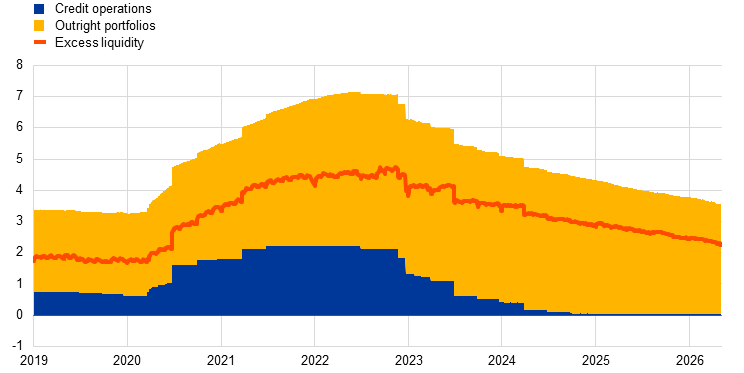
The average amount of liquidity provided through monetary policy instruments fell by €145 billion to €3,632 billion over the review period (Chart B). This decline was almost exclusively due to the €144 billion reduction in Eurosystem outright monetary policy portfolio holdings, following the continued redemption of APP and PEPP holdings in the absence of any reinvestments. This brought the amount of liquidity provided by these portfolios down to €3,608 billion over the review period.
Chart B
Liquidity provided through open market operations and excess liquidity
(EUR trillions)
Source: ECB.
Note: The latest observations are for the second maintenance period of 2026.
The average amount of liquidity provided through credit operations remained stable at €24 billion over the review period. The average outstanding amounts of main refinancing operations (MROs) and three-month longer-term refinancing operations (LTROs) were unchanged at €13 billion and €11 billion respectively. Participation in these regular operations remains limited, reflecting the comfortable liquidity position of banks and the good availability of alternative market-based funding sources. However, the number of banks that are testing the viability of their participation has been growing in 2026, indicating that they are building up their operational readiness to access these operations as the balance sheet of the Eurosystem continues to contract.
Excess liquidity
Excess liquidity fell by €112 billion to €2,358 billion over the review period (Chart B). Excess liquidity is the sum of the reserves that banks hold in their current accounts in excess of the minimum reserve requirements and their recourse to the deposit facility net of their recourse to the marginal lending facility. It reflects the difference between the total liquidity provided to the banking system via monetary policy instruments and the liquidity needed by banks to cover their minimum reserves. Since peaking at €4,748 billion in November 2022, excess liquidity has declined steadily.
Interest rate developments
During the review period, the Governing Council kept the three key ECB interest rates unchanged – including the deposit facility rate, through which it steers the monetary policy stance. The rates on the deposit facility, MROs and marginal lending facility remained at 2.00%, 2.15% and 2.40% respectively (Table B).
The average euro short-term rate (€STR) went up marginally over the review period, resulting in a slightly less negative spread relative to the deposit facility rate. On average, the €STR was 6.8 basis points below the deposit facility rate, compared with 7.0 basis points during the seventh and eighth maintenance periods of 2025.
The average euro repo rate, as measured by the RepoFunds Rate Euro index, remained closer to the deposit facility rate than the €STR over the review period. On average, the repo rate exceeded the deposit facility rate by 0.7 basis points, which is marginally more than in the previous review period.
Table A
Eurosystem liquidity conditions
(averages; EUR billions)
Source: ECB.
Notes: All figures in the table are rounded to the nearest €1 billion. Figures in parentheses denote the change from the previous review or maintenance period. MROs stands for main refinancing operations and LTROs for longer-term refinancing operations. The historical time series of Eurosystem liquidity conditions can be found in the ECB Data Portal under the table tab of the liquidity report.
1) Memo item that does not appear on the Eurosystem balance sheet and should therefore not be included in the calculation of total liabilities.
2) Computed as the sum of current accounts above minimum reserve requirements and the recourse to the deposit facility minus the recourse to the marginal lending facility.
3) Computed as the sum of net autonomous factors and minimum reserve requirements.
4) Computed as the difference between autonomous liquidity factors on the liabilities side and autonomous liquidity factors on the assets side.
Table B
Interest rate developments
(averages; percentages and percentage points)
Sources: ECB, CME Group and Bloomberg Finance L.P.
Notes: Figures in parentheses denote the change in percentage points from the previous review or maintenance period. MROs stands for main refinancing operations and €STR for euro short-term rate.